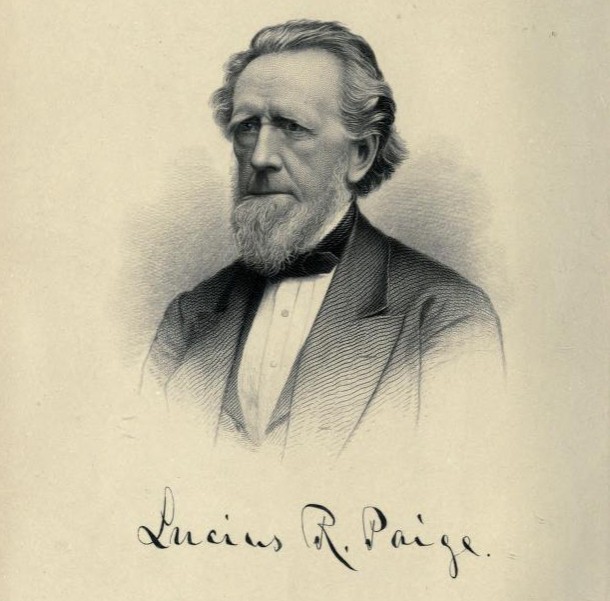
Do You Know This Man? Cambridge Historians Do
Lucius Paige: Polymath, Theologian, Reverend, Historian, Author, and Town Clerk Extraordinaire

In a town known for its illuminati, Lucius Paige is usually not top of mind. But, without his mind we would not know as much about early Cambridge as we do. Why is that?
Professional Life
Lucius Paige was Transcriber-in-Chief of the oldest Cambridge City Records dating back to the early 1600s. Not only did he transcribe the City’s records, but he also scoured the Massachusetts Historical Society, the Records and Archives of the Commonwealth, judicial and court documents, the records of several relevant surrounding towns, and any other historical depositories that were available. His book The History of Cambridge, Massachusetts 1630-1877, with a Genealogical Register, published in 1877, is an astonishing accomplishment that has brought to life the earliest history of the city. His book illuminates the thoughtfulness the first settlers brought to organizing a town government and civil society. The reach of his research, and his skill in organizing his studies into a comprehensible narrative, has made ordinary life in Cambridge from the 1600s onward accessible. This extensively footnoted book is the go-to source for Cambridge history from the period of early settlement to its development as a bustling city.
For instance, from Paige’s transcribed, typeset, and proofed pages, it is easy to find the exact date that the town Cambridge got its name:

Lucius Robinson Paige was born in 1802 in Hardwick, Massachusetts. He was educated at what would become Hopkins Academy in Hadley, Mass. Raised in a Calvinist household, he became a Unitarian and began preaching at the age of 21. He left active preaching in 1839 and became the Town Clerk until 1846 and then City Clerk until 1855, participating in that historic transition of municipal government. He was Justice of the Peace (1843), Representative to the Massachusetts Court (1878-1879), and served on several bank and business boards. He was one of the earliest members of the New England Historic Genealogical Society. He received an honorary MA from Harvard in 1850. He was an early contributor to Tufts and served on its board of trustees for 14 years. In 1861, Tufts University awarded Paige an honorary Doctor of Divinity.
It was during his stint as the Town Clerk of Cambridge that Paige found the town’s municipal records in dismal order. He contracted with the City to transcribe them. For transcribing the first volume he was paid $250 for 550 pages. Then, on May 3, 1841, he wrote to the Selectmen:
“The records of the Proprietors of Cambridge are in a shattered, perishing condition, and a considerable portion of them are written in the ancient character, and, to most persons, are illegible. They are believed to contain matter too valuable to be lost; but they cannot easily be preserved and made available, except by transcribing them.”
He was willing to transcribe the Proprietor’s Records for the same price, even though they would amount to approximately 250 more pages than the first project, because “as I have become familiar with the hand-writing, my actual labor will not be greater in the same proportion.” Yet he had to confess that: “At the same time, I will not disguise the fact, that I feel an interest in this subject, not only as a citizen of the Town, but also as an individual.”
The Town agreed. As he states in the preface to his book in 1877, the Genealogical Registry “is chiefly confined to the families who dwelt in Cambridge before the year 1700…” Paige also comments that “comparatively few recent events are mentioned. It would be impracticable, in a single volume, to include with our ancient annals everything which those who are now living have witnessed, and to trace the genealogy of all our nearly fifty thousand inhabitants.”
In his usual self-effacing way, he acknowledges that some might find the history short on Harvard details, the Revolution, or “legendary lore.” Addressing the latter, he states that, because he was not born in Cambridge, he had “no opportunity in the first 30 years of my life to gather the local traditions which so deeply impress the youthful mind…”
His diagram of the city of Cambridge in 1635 was accompanied by the names of each of the 63 land holders in the numbered diagram below. These included four of the first inhabitants listed on the title page of the Town Book of Newtowne, first begun in 1632: Simon Bradstreet (#27) Thomas Dudley (#55), William Spencer (#31), and the widow of Symon Sacket (#37). The area marked #24, designated the “Marketplace,” is now Winthrop Square.

Apart from recording the standard history of land development and civil government, from these pages we also learn about such 17th-century charming esoterica as:
Keeping goats (pg. 41)

Roaming dogs (pg. 96-7)

The comfort of cows (January 4, 1635-6, pg. 37)

Chickens running loose. (April 4, 1636, pg. 39)

More serious subjects include:
Early city planning (January 7, 1632-3, pg. 18)

House fires (pg. 56)

The Cambridge History Room in the city’s Public Library holds a collection of Paige’s original drafts in his own handwriting, which, interestingly, include his editorial corrections:


The layout of this genealogical chart is particularly interesting:


Paige’s prodigious published output is remarkable. Not only did he publish The History of Cambridge, but, at the same time, he produced other histories, religious tracts, and genealogies:
An Address at The Centennial Celebration in Hardwick, Mass (November 15, 1838)
Commentary on the New Testament in six volumes (1844)
List of Freemen of Massachusetts, 1630-1691 (1849)
Selections From Eminent Commentators, Who Have Believed in Punishment After
Death: Wherein They Have Agreed with Universalists in Their Interpretation (1858)
Questions On Select Portions of The Gospels: Designed for The Use of Sabbath Schools And Bible Classes (1863)
History of Hardwick, Massachusetts, with a Genealogical Register (1883)
Personal Life
Lucius R. Paige was a direct descendent of William Brewster, who came to New England on the Mayflower, and the Governor of the Massachusetts Bay Colony Thomas Dudley. His grandfather served in the Revolutionary War and his father was a Minute Man. The earliest digitized Town Directory is 1847, which finds him living at 96 Washington Street. He lived there for at least 20 years before moving to 112 Washington St.
Paige apparently suffered from poor health, as this excerpt from an article in the Boston Globe (June 30, 1914) describes:

Paige’s adult life was rife with sadness. He lost three wives; only his fourth wife, Ann Maria Peek, whom he married in 1866, survived him. She died five years later in 1901. He had five children, only two of whom reached the age of 25. Three died in infancy. This included his first child, named Hosea Ballou Paige, in honor of Paige’s mentor Hosea Ballou. Ballou is buried in Mt. Auburn, Lot #103 Central Ave.

Lucius Robinson Paige is buried in the Mount Auburn Cemetery, Lot #2008 Sorrel Path. He was initiated into the Masons as a clergyman in 1824 – the Mason symbol can be seen on his headstone. Each of his family members are buried in this lot.


Today’s post was written by CHC volunteer Kathleen M. Fox
Sources
Ancestry.com
Cambridge Historical Commission reference files
Cambridge Public Library’s Historic Cambridge Newspaper Collection
Kenney, Michael and Cambridge Historical Commission. The Streets of Cambridge: An Engineer’s Passion (2018). https://www.cambridgema.gov/-/media/Files/historicalcommission/pdf/hastings_engineer.pdf.
Lucius R. Paige Papers, 1644-1881, Cambridge Room, Cambridge Public Library Archives and Special Collections.
Mount Auburn Cemetery
Newspapers.com
North America, Family Histories, 1500-2000 [database on-line]. Ancestry.com.