Today would have marked the 85th birthday of Saundra M. Graham, Cambridge community activist and politician.
Saundra was born in Cambridge on September 5, 1941 and attended public schools here, later going on to the University of Massachusetts and Harvard University Extension. Saundra moved to Boston after marrying Carl Graham, Sr. in 1958. Following the couple’s divorce, Saundra returned to Cambridge in 1968 to raise her five children, settling in the Riverside neighborhood.
Cambridge City Council, Police Brutality Hearings, Civil Rights lawyer William Homans (top left), Saundra Graham (bottom left), and Joanne Pelham (bottom right), January 1971. Photographed by Olive Pierce. Cambridge Room, Cambridge Public Library Archives and Special Collections
That year, Saundra joined the Board of Directors of the Cambridge Community Center. In 1971, she helped found and became president of the Riverside Cambridgeport Community Development Corporation, which provided and upgraded low- and moderate-income housing for Cambridge residents. During the 1970 Harvard commencement, Saundra led a protest against the university’s expansion into and eviction of long-time Riverside residents. The protest succeeded in compelling the university to construct inclusive housing complexes over the next ten years.
In 1971, Saundra became the first woman of color to be elected to the Cambridge City Council. As City Councilor, Vice Mayor, and later State Representative, she played a key role in obtaining federal housing dollars for Cambridge that resulted in rehabilitation and modernization of public housing. In 1976, Saundra was elected as State Representative, a seat she held for twelve years, becoming the first black woman representative from Cambridge to the State House. She continued to work for fair housing in the legislature and was dedicated to obtaining economic justice for the poor, elderly, unemployed, minorities and women.
New City Council – Members of the Cambridge City Council are posed here following inaugural ceremony at City Hall. Front, from left, Out-going Mayor Walter J. Sullivan, Saundra Graham, Alfred E. Vellucci, senior councilor in 12th term; Barbara Ackermann and Thomas W. Danehy. Rear, Joseph Connarton, deputy city clerk; Leonard J. Russell, Daniel J. Clinton, David E. Clem, new councilor; Francis H. Duehay and City Clerk Paul Healy. Photographed by Ed Pacheco, 1976.
Saundra passed away on June 23, 2023. Though her accomplishments are too numerous to list here, a portion of her obituary emphasizes her dedication to public service: “Saundra was a stalwart of her community. She was a champion for all and spent her lifework ensuring that family, neighbors, the community, and the people of the State of Massachusetts were seen, heard, valued, and uplifted. She was the voice of the people and a beacon of change.”
Our publication Common Cause, Uncommon Courage: World War II and the Home Front in Cambridge, Massachusetts is the product of a four-year effort to record the experiences of more than 125 Cambridge veterans and home front participants. These recollections are told by soldiers in combat, nurses in hospitals in Europe and the Pacific, women who worked at the Charlestown Navy Yard and other defense industries, and servicemen’s families who waited for loved ones to come home. Five POWs, a Holocaust survivor, and an Italian Jewish refugee tell stories of uncommon courage and determination to persevere and survive in extraordinary circumstances. A narrative of the war in the European and Pacific Theaters accompanies the oral histories, and more than 250 photographs, some from the National Archives and FDR Library, are included as well.
Cover of Common Cause, Uncommon Courage: World War II and the Home Front in Cambridge, Massachusetts (2009)
The following passage comes from the section “Prisoners of War (POWs)” where Private First Class Armando DeVito shares his experience during the Battle of the Bulge:
“When we went out of the Ardennes, we had hardly any equipment left, and we were waiting for air support, which we didn’t get. We were in this gully with German Tiger tanks all around us, and we didn’t have much ammunition left. We were trying to dig in to keep low. All we had were rifles—no heavy equipment. We were all facedown. We didn’t dare move, because they were all around us.”
To learn the conclusion of DeVito’s harrowing journey and hear about the efforts of many other Cantabrigians during this conflict, stop by our office or click here and obtain your own copy of this rich oral history book! For more information, email us at histcomm@cambridgema.gov.
Page from POW Francis Cunningham’s record of Red Cross parcel received, ca. 1944
The publication We Are the Port represents a five-year effort to interview more than 125 longtime Port residents of diverse backgrounds. Over the course of 150 years, the Port faced many challenges – from the federal anti-immigrant acts of the 1920s to plans for an Inner Belt highway that would have displaced many families and businesses. In the last fifty years, residents have joined the struggle for civil rights, including needs for educational parity and a more responsive city government. The community has weathered the winds of change, from the construction of Newtowne Court and Washington Elms in the mid- to late-1930s to the redevelopment of Kendall Square. The generational family stories inspired and moved the author, Sarah Boyer; many shared accounts of the courage of those who left their native countries to face an unknown world, toiling to provide for their families and improve the lives of their children and succeeding generations.
Ruby Higginbotham, her daughter, Suzanne Revaleon, and her son, Paul Revaleon (in carriage), outside 9 Worcester Street, ca. 1920
The following selection of passages comes from the section “Growing Up on Worcester Street” by Suzanne Revaleon Green (1912-2012):
“There were many children in the neighborhood, and we spent many hours playing together. As a little girl, I can remember standing in our bay window at dusk to watch the lamp lighter ride up the street on his bicycle to light the gas lamp at the corner of Norfolk and Worcester Streets.
My father, with the help of our next-door neighbor, a retired Irish carpenter, built me a playhouse in our yard. Parts of its construction came from the demolishing of some beautiful old houses on Norfolk Street, where new apartment houses were being built.
I walked to the Fletcher School on Elm Street each day and returned home for lunch, returning for school within an hour for the afternoon session. We all attended our nearest neighborhood schools.”
To learn more about Suzanne’s experience and those of many others who grew up in Cambridgeport, stop by our office or click here and obtain your own copy of this rich oral history book! For more information, email us at histcomm@cambridgema.gov.
Join filmmaker Federico Muchnik for a special premiere screening of his new documentary, Massachusetts Avenue: Life Along Cambridge’s Main Artery, showing at The Brattle Theatre on Saturday October 18th starting at 12pm.
“A high-flying whirlwind grand tour of Mass. Ave. featuring stunning aerial cinematography, revealing interviews with small business owners, controversial news-making stories (the MIT and Harvard encampments), a look at the city’s political life and the Ave’s history, Central Square’s dance party as seen from above, more dance (!), our local music scene and, of course, the turkeys.”
October is Queer History Month and today we’re honoring the late Mary Leno, a long-time resident of Cambridge, who passed away on September 4, 2025.
Mary was born on November 11, 1940, in Ipswich, MA, where she lived throughout her high school years. Mary worked hard for social justice. She was active in advocating for the LGBTQ community, low- or no-income people, women, and housing justice. Her work for equal rights and dignity for the LGBTQ community earned her a special award from the Cambridge City Council at the city’s annual Pride Brunch. She was a lifelong lesbian. She was a strong advocate of housing for all, and initially moved to Cambridge because the city had rent control.
Mary worked for the Cambridge Commission on the Status of Women for 20 years. She was the cornerstone of Cambridge Women in Cable, a collective that produced programming about women’s issues, perspectives, and experiences, at Cambridge Community Television from the late 1980s to the early 1990s. She starred in a skit called Ladies Against Women Against AIDS with her long-time partner, the late Betty Furdon, and another friend, dressed as conservative older women discussing the AIDS epidemic. She initiated the weekly BeLive series Women in the Arts, Women in Labor, and Women in Health.
Mary recently participated in the Lesbian Coffee Shop hosted by Lesbos, a lesbian-centered community organization. View an excerpt from that talk here:
She was active with and volunteered for the Cambridge Women’s Center, the Women’s School, Food for Free, and the Eviction Free Zone. Mary took great pleasure driving her friends and neighbors places through her self-named Senior Lesbian Urban Transport (S.L.U.T.).
Mary was a daily visitor to Graffiti Alley in Central Square with her step-dog Al and his successors Desi, Bella, and Rosie. One of her photos was chosen for the 2025 Cambridge resident parking sticker.
Graffiti Alley photographed by Mary Leno
She was a photographer and chronicler of social movements. For many decades she photographed graffiti, and later added protest signs and protest t-shirts. Her vast political button collection (the Mary M. Leno Button Collection) is archived at the Cambridge Public Library and Northeastern University.
A box of buttons documenting LGBTQ- and AIDS-related activism. Mary M. Leno button collection, Northeastern University Archives.
Mary would like to be remembered for having a good sense of humor and wrote her own obituary:
She was born and then she died. So long, it’s been good to know you.
All are invited to a Celebration of Mary’s rich life on Sunday, October 19th from 1-4 pm at Sonia at the Middle East Restaurant in Cambridge, 480 Massachusetts Avenue, entrance on Brookline Street. Donations may be made to Just A Start (justastart.org).
Ration book for Rose Shapiro Brown, college graduate, of Cambridge. Image: Cambridge Historical Commission.
80 years ago, on August 15, 1945, Emperor Hirohito of Japan surrendered, though the official ceremony took place later that year on September 2. Thus marked the end of World War II. This anniversary brings to mind an aspect of daily life on the home front during the war that many today may not know much about: rationing and salvaging. How the needs of WWII permeated daily life has not been seen in subsequent wars and is nearly inconceivable today. As you read this piece, consider how profoundly altered your daily life would be if a similar system were put in place today. In the United States, rationing began in early 1942 and formally ended in 1947.
After the bombing of Pearl Harbor in 1941, joining the war created an immediate and substantial need for metals, electricity, gasoline, food, clothing, tires—virtually everything—to support war production. This led to the rationing system which was designed to ensure that enough essential materials were available for weapons and troop support. Secondarily, rationing aimed to equalize the distribution system for all commodities among citizens and control inflation.
The Office of Price Administration (OPA) was created to administer the rationing system. Subsequent Acts of Congress further regulated rents and wages, and regulated the cost of living.
“When you have used your ration, salvage the Tin Cans and Waste Fats.They are needed to make munitions for our fighting men. Cooperate with youLocal Salvage Committee.” Image: The National WWII Museum, New Orleans. https://www.nationalww2museum.org/
How did the system work?
It was very, very complicated. Administering the program required 8,000 Ration Boards in cities and towns across the country. Ration Books like those above included stamps which did not have a dollar value, but, in addition to dollars, they were required for every purchase. Each member of a family (including infants and children) was required to have a ration book in their name. A person registering for ration books for a whole family needed to present the names, height, weight, eye color, hair color, and sex of each family member and state their relationship to them (natural born, adopted, spouse, etc.).
The books were issued monthly: if the books were used up, the customer had to wait for the succeeding month’s book to get enough stamps to purchase the item. In addition, stamps were numbered to be used only for a specific period of time to prevent hoarding. When the time limit was reached, the stamp was voided. Information about where to get War Ration Books and how to use them was posted in the newspapers leading up to the distribution event. In Cambridge, the books were distributed at public schools.
Stamps had a variety of images: airplane, torch, tank, aircraft carrier, wheat, fruit, etc. as well as alphabetic lettering:
Images gathered from eBay and Yahoo Image Search
Point Rationing
In addition to ration stamps, the system of “Point” rationing was particularly complicated. The point value of a particular item was based on the current availability of the product. This meant that point values changed depending on the supply and demand. The Office of Price Administration published regular updates on changing values:
The Cambridge Sentinel January 23, 1943 (excerpt)
First National grocery store advert (excerpt) as published in The Cambridge Chronicle March 23, 1944
Eventually, the government also issued dime-sized tokens to enable vendors to make “change” for stamps. Red tokens were used as change for red stamps and blue tokens to make change for blue stamps.
The details in the articles below illustrate just how much there was to keep track of before you went to the grocery store!
The Cambridge Sentinel March 6, 1943
The Cambridge Sentinel April 24, 1943
“How to Shop With War Ration Book Two… to Buy Canned, Bottled and Frozen Fruits and Vegetables; Dried Fruits, Juices and all Canned Soups.” Office of Price Administration, February 1943. Collection of the National Archives and Records Administration (NAID: 514549).
Got it? When making purchases, the correct stamp had to be torn out of your book in front the cashier. You could not redeem detached stamps. This was to discourage the black-market stamp trade.
“Stamp Out Black Markets With Your Ration Stamps” WWII Posters Collection, World War II Papers, Military Collections, State Archives of North Carolina.
The first item rationed by the OPA, on December 21, 1941, was rubber. The quota for Cambridge was set at 300,000 lbs.
The Cambridge Sentinel December 20, 1941
In addition to collecting the obvious objects like rubber tires, other items collected for this rubber drive included girdles, rubber shoes, bed pans, gloves, floor mats, and crutch tips. The Central Square Theatre put on a free show for children arriving with rubber scraps. They collected 2.5 tons!
The Cambridge Chronicle July 16, 1942
In the case of toothpaste (which came in metal tubes), before you could purchase a new tube you had to hand over the empty tube so that the metal could be recycled for the war effort. One advertisement stated that “thirty-two toothpaste tubes contain the tin needed for a fighter plane.”
A War Production Board poster encourages Americans to contribute items made with tin to be recycled for use in the war effort. Credit: War Department via defense.gov.
Rationing Food
“…one-fourth of all the food that is going to be produced here during 1943 will go to U. S. armed forces, outside of its boundaries to feed the peoples of the United Nations and those peoples in lands occupied by the Axis…”
TheCambridge Sentinel January 23, 1943
To address complaints of citizens about the privations of rationing system, and in particular, about the U.S. sending food to our allies, the Director of the Office of War Information (OFI) Elmer Davis, delivered a radio speech on December 27, 1942 explaining the reasoning behind this aspect of the system:
“This war can be won only by killing enough Germans to discourage the rest of them. Enough Japanese too, but we can leave them out of this discussion; since in the Pacific area we get food from our allies, instead of sending it to them. Now the Russians, so far, have killed more Germans than everybody else put together; and that is why it makes sense for us to send food to Russia…We send food to the Russian army, because every German who is killed by a Russian is a German whom we won’t have to kill; or, for that matter, a German who will never have a chance to kill American Soldiers.”
New York Times December 28, 1942
After rubber, the next item to be rationed was sugar. Alerts about sugar shortages went out about three months after Pearl Harbor.
“Consumers will have to certify the amount of sugar they have on hand when they register for war ration book No. 1…Each person was allowed to have two pounds of sugar prior to registration. For all sugar in excess of two pounds per person, stamps were torn out of the ration book, preventing further purchase of sugar until the hoards are used up….”
TheCambridge Sentinel March 7, 1942
Book of 5-Pound Home Canning Sugar Coupons, ca. 1943. Robinson and Via Family Papers, National Museum of American History.
The Cambridge Chronicle April 30, 1942
Automobiles, Gas, and Mileage
As well as rationing fuel, gas and mileage rationing was another way to manage the use of rubber and the consumption of gasoline. All car owners had to register their cars for the relevant sticker determined by their car usage. Some of these included:
A = Basic sticker for passenger cars. Allowed 3 to 4 US gallons of gas per week and max 150 miles/mo.
B = For those who could prove that their job required driving more than 150 miles per month. They also had to carry 3 or more passengers. 8 gallons of gas/week.
C = Supplemental sticker for those whose “professional” job required up to 470 miles/mo. (Doctors, dentists)
D = Motorcyclists essential to the war effort. Same ratio of miles as the “A” sticker. 2 gallons/wk.
R = Non-highway vehicles such as tractors.
T = Commercial trucking: 5 gal/wk.
X =Highest priority stickers for those with extraordinary mileage allowances. Some Congressmen also wrangled these. Unlimited gasoline.
Soon enough the joke was circulating that “OPA” stood for “Only A Puny A-Card.”
With the exception of shoes, (rationed beginning in 1943) clothing in general was not rationed. However, since textiles such as wool (for uniforms) and silk (for parachutes) were needed in the war effort, and because clothing factories switched from making civilian clothes to military uniforms, supply was limited. The War Production Board encouraged people to consider reusing, sewing, and mending clothes as their patriotic duty.
1943 Poster: Use It Up, Wear It Out, Make it Do! by Robert Gwathmey. Courtesy PosterGroup.com
1942 poster, Work Projects Administration for the City of New York. War Services.National Museum of American History.
In addition, in 1942, the War Production Board did put restrictions on clothing manufacturers via a policy referred to as the “L-85 Regulations,” limiting how much fabric manufacturers could use to produce civilian clothing. This meant that women’s skirts became shorter, used fewer buttons, and eliminated flaps on pockets and “balloon” blouse sleeves. Men’s suits also had no pocket flaps, narrow labels, and were only single breasted.
The Salvage Operation
Salvaging materials to meet the needs of war production was immense and equally as important as rationing. The clips below effectively illuminate the reasoning, communications, and the systems for salvage collection. Most compelling were those articles that outlined how many pounds or tons of an item were needed to produce specific war necessities. For instance, in the “Save Scrap” advert below we learn that 25 pounds of wastepaper can make eight shell containers. Posters were excellently designed—look at the view down the barrel of an artillery gun (below) calling for saving waste fats. The language and images used to encourage salvaging are so vivid they speak for themselves. And don’t miss the last item in this news report re: ladies hosiery!
The Cambridge Chronicle January 29, 1943 (excerpt)
The Cambridge Sentinel April 18, 1942
The Cambridge Sentinel October 10, 1942
The Cambridge Sentinel September 19, 1942
Scrap iron for war effort, WWII. Courtesy of the Boston Public Library, Leslie Jones Collection.
The Cambridge Sentinel September 5, 1942
The Cambridge Sentinel February 6, 1943
“One tablespoonful of kitchen grease fires five bullets.” “One pound of kitchen fats makes enough dynamite to blow up a bridge.” Poster: Save Waste Fats For Gunpowder, artist unknown. Courtesy PosterGroup.com
The Cambridge Sentinel October 28, 1944
War ad calling for waste fats collection. Image via Reddit.
Poster “Waste Paper Makes Containers for Blood Plasma” ca. 1941-45. National Archives and Records Administration.
The Cambridge Chronicle November 18, 1943 (excerpt)
Cambridge aiming to collect 555,000 pounds of wastepaper:
The Cambridge Sentinel November 27, 1943
Virtually all countries – Axis or Allied – had a rationing system during the war. In the United States, rationing was ended in stages as supply met demand, but goods remained in short supply after the war.
Rationed Items
Rationing Duration
Tires
January 1942 to December 1945
Cars
February 1942 to October 1945
Bicycles
July 1942 to September 1945
Gasoline
May 1942 to August 1945
Fuel Oil & Kerosene
October 1942 to August 1945
Solid Fuels
September 1943 to August 1945
Stoves
December 1942 to August 1945
Rubber Footwear
October 1942 to September 1945
Shoes
February 1943 to October 1945
Sugar
May 1942 to 1947
Coffee
November 1942 to July 1943
Processed Foods
March 1943 to August 1945
Meats, canned fish
March 1943 to November 1945
Cheese, canned milk, fats
March 1943 to November 1945
Typewriters
March 1942 to April 1944
Duration of commodities rationed in the United States during WWII. Courtesy Ames History Museum.
After the War
The complexities of transitioning from wartime production to peacetime production was anticipated as early as 1942, as seen in this in this excerpt from an article just as rationing was beginning:
The Cambridge Sentinel January 17, 1942
Manufacturers Do Their Part
Wartime needs produced a boom in manufacturing. Many American companies pivoted their manufacturing capabilities to support the war effort. One such company was Maidenform, a manufacturer of women’s bras, underwear, and shapewear. Maidenform began producing vests and parachutes for homing pigeons who accompanied paratroopers and often delivered critical messages. For more on this astonishing story, read “Pigeons in bras go to war” by Lindsay Keating: https://americanhistory.si.edu/explore/stories/pigeons-bras-go-war.
After the war, retooling factories for peacetime production presented a different sort of challenge such as shifting from making tanks to making cars. Nonetheless, celebration prevailed:
The Cambridge Chronicle September 13, 1945
Today’s post was written by CHC volunteer Kathleen M. Fox
On the night of April 18, 1775 while Paul Revere was bolting on horse from Charlestown to Lexington warning of the advancing British, his colleague William Dawes Jr. (1745-1799) was likewise galloping out of Boston in the opposite direction. Dawes was a second sergeant in the Ancient and Honorable Artillery Co. of Massachusetts. Earlier, having already managed to steal a couple of cannons out from under the nose of British soldiers, he was already active in acts of subterfuge.
Dr. Joseph Warren of Bunker Hill fame organized both men, believing two riders had a better chance of getting through than just one. The 30-year-old Dawes, member of the Sons of Liberty and father of six children, departed around 9:00 pm, about an hour before Paul Revere. Sticking to the Boston side of the river, Dawes crossed the Boston Neck (120 ft wide at high tide), successfully crossing through the British checkpoints. It is generally thought that because his profession as a tanner often required him to ride out on business (not to mention his pretending drunkenness in taverns to pick up intelligence from British soldiers), he was a familiar face to the sentries who let him through without question. This trip was no exception.
After crossing the Neck, Dawes galloped through what is now Roxbury, Brookline, and Allston, finally crossing over “The Great Bridge” to Cambridge. Most Cantabrigians are familiar with what is now known as the Anderson Memorial Bridge, which connects the Harvard Square side of the Charles River with the Harvard Stadium side. But did you know the role this bridge played in the Revolution?
Boston Neck in the red circle on the right; Cambridge red circle on the left. Arrow showing Great Bridge location. Detail: Boston, 1775, Siege, Battle of Lexington & Concord, Framed Revolutionary War Map courtesy Battlemaps.us.
Built in 1660 from “Little Cambridge” on the south side of the Charles to Cambridge on the north, this timber bridge was the first to span the Charles River. Over the centuries, deteriorating conditions led to several repair iterations, including adding a draw for barges passing upstream. The bridge that we see today – the Anderson Memorial Bridge – was rebuilt in 1915.
After Dawes crossed the river late that night, well prepared Cambridge citizens removed its planks to impede British General Hugh Earl Percy and his troops from literally following in Dawes’s hoofprints. According to the diary of British Lt. Frederick Mackenzie in Gen. Percy’s army, the troops did not mobilize until 8:45am on the 19th:
“…that they were- to march out of town to support the troops that went out last night. A quarter before 9, we marched in the following order, Advanced Guard, of a captain and 50 men; 2 Six pounders, 4th Regt., 47th Regt, 1st Batt. Of Marines, 23rd Ret., or Royal Welch Fusiliers, Rear Guard, of a Captain & 50 men. The whole under the Command of Brigadier General Earl Percy. We went out of Boston by the Neck, and marched thro’ Roxbury, Cambridge and Menotomy, towards Lexington. In all the places we marched through, and in the houses on the road, few or no people were to be seen; and the houses were in general shut up.”(Diary of Frederick Mackenzie, officer of the regiment of Royal Welch Fusiliers during the years 1775-1781)
Thats a lot of soldiers! Percy’s troops found the bridge planks, reinstalled them, and eventually followed in Dawes’s path to Lexington.
Portrait of Hugh Percy, Second Duke of Northumberland by Gilbert Stuart, c. 1788, High Museum of Art
(Later that summer, in July of 1775, George Washington also passed over the bridge to attend the funeral of Col. Thomas Gardner, who was wounded in the Battle of Bunker Hill and died on July 3, 1775 at home in Little Cambridge, now Brighton).
The Anderson Bridge about 1900. The tugboat with smokestack on the left is waiting for the draw to open. Cambridge Historical Commission
Arriving on the north bank of the Charles, Dawes would have stepped onto a causeway crossing the mud flats, passing alongside the “Colledge” Wharf at the end of Wood Street. Wood St led up to what is now Harvard Square and was subsequently called Brighton Street in 1838, renamed to Boylston Street in 1882, and renamed to its current designation, John F. Kennedy (JFK) Street, in 1982.
The Route
Recreated map: Cambridge in 1775 by Robert Ballou Lillie (1949) with path of William Dawes in red
It is startling to realize that along his way through Cambridge Village (as it was referred to at the time), Dawes would have passed by some of the same buildings and places that we still see today. Today, we see the house of carpenter John Hicks at 64 JFK Street, across from the Eliot Street intersection. Dawes would not have passed the house at its current location: it was originally built in 1762 on the corner of Dunster and Winthrop Streets and later purchased by Harvard and moved to its current location at 64 JFK St in 1928.
Photograph of John Hicks House as it appeared in Historic Guide to Cambridge by Hannah Winthrop Chapter D.A.R. (1907) when standing at its original location of Dunster and Winthrop Sts
But Hicks, also an active patriot, having already taken part in the Boston Tea Party, was no doubt aware of Dawes’s travels just a block away. In fact, the next afternoon, April 19, while ambushing the retreating British soldiers at the corner of Mass Ave and Rindge Ave (then called Watson’s corner), Hicks was shot dead. Later, General Israel Putnam used the house for his office during the war.
The Hicks house today at 64 JFK Street. Image: Kathleen Fox
The first location, still in the same place that Dawes would have passed, was the Market between Winthrop Street and Mount Auburn Street, then known as Long Street and Spring Street. This land was originally that of Sir Richard Saltonstall. Following his return to England, the lot was designated a public marketplace in 1635. In 1834, it was enclosed as a park and dubbed “Winthrop Square.” The current park reflects the restoration done in 1987.
Image: Kathleen Fox
Winthrop Square in 1889. Cambridge Historical Commission
Winthrop Park today. Image: Kathleen Fox
And just past Mt. Auburn St on the left, Dawes would have passed the Ebenezer Bradish’s Blue Anchor Tavern, a popular watering hole for political discussions, where monthly meetings of Selectmen took place. The “joint was jumping” on the night of the 18th as news of the British troops arrival spread. The original tavern building is long gone, but the place is marked by a Cambridge Historical Commission blue oval. Today, this is the location of Union Square Donuts, 15 JFK St.
Contemporary view of the former location of the Blue Anchor Tavern. Images: Kathleen Fox.
Wood Street ended at what was then a small common and is now is now Harvard Square. Dawes passed The Courthouse on the left, situated about where the Harvard Coop is today. The small common is now the traffic island and entrance to the MBTA.
Court house (1758) and Prentice-Webber House (1750). Harvard University Archives Image: https://hls.harvard.edu/today/two-professors-six-students-three-rooms/. Harvard Law School Historical and Special Collections. Boyd, William (Harvard College Class of 1796). Mathematical thesis, 1796
Middlesex County Courthouse, Harvard Square (1758). Harvard University Archives, HUC 8782.514 (82). Robert Hallowell, “Northeasterly Perspective View of Cambridge Court House Taken from “the Stone Bridge”
Across from the Courthouse was the Fourth Meeting House, built in 1758. This is now the site of Lehman Hall, across from the Harvard Square Kiosk.
Fourth Meeting House Marker
Location of marker in Harvard Square (Google Street View)
If Dawes looked to his right while riding past the Courthouse, he would catch a fleeting view of Wadsworth House, located just to the right of the Fourth Meeting House. Built in 1726, Wadsworth House was the residence of Harvard presidents until 1849. It served as Gen. Washington’s first command center for two weeks before moving to the Vassall estate on Brattle St (now the Longfellow House). While Washington’s HQ was in Wadsworth, then-president of Harvard, Samuel Langdon, was permitted to continue living in one of its rooms. The two small wings seen below were added in 1783.
View of Wadsworth House ca. 1920. Cambridge Historical Commission
Continuing out what is today Mass Ave, Dawes passed five Harvard buildings that in 1775-1776 were used as barracks for Provincial troops. The Paul Revere print below (1767) shows three of these five buildings (left to right): Harvard, Stoughton, and Massachusetts Halls. Hollis Hall, not visible in the print, is tucked in behind the northeast corner of Harvard Hall, and Holden Chapel is also out of view to the left of Harvard Hall. Both were in existence at the times of Dawes’s ride. Massachusetts Hall accommodated 640 soldiers; Stoughton: 240; Harvard Hall an indeterminant number; Hollis Hall 640; and dinky Holden Chapel, believe it or not, housed 160 men.
“Westerly view of the Colledges in Cambridge, New England, 1767 ; Revere view of Harvard” (1767). Revere, Paul, 1735-1818, creator, engraver. Chadwick, Joseph, artist, approximately 1721?-1783. Harvard University Archives.
Massachusetts Hall (above right)was built in 1720 as a student dormitory. Today, the first two floors are taken up with the office of the president, provost, general counsel, vice presidents and their support staff. The upper two floors still serve as dorm rooms for about 24 Freshmen.
Massachusetts Hall, Harvard University, photographed by Ralph Lieberman (2012). Harvard Fine Arts Library, Special Collections
Stoughton Hall (middle building in the Revere print above) was completed in 1700 and served as a student dormitory. Over time it was deemed in such need of repair that it was declared “an unsubstantial piece of masonry,” and taken down in 1780. The current University Hall, built between 1813-1815, took its place. The second brick Stoughton Hall is seen today is on Mass Ave to the left of the Holden Chapel. It was opened in 1806.
Stoughton Hall photographed by William Notman & Son, 1874. Theodore Roosevelt Collection 560.12-021, Harvard University
Harvard Hall (left building in Revere’s print above). The first Harvard Hall, built in 1682, served as the university library, chapel, lecture hall, dining hall and meeting place. When it was destroyed by fire in 1764, lost were nearly of the Library’s books, along with various “philosophical apparatus” such as telescopes, medical instruments, and microscopes. By 1766 it had been rebuilt. The Harvard Hall in the Revere engraving represents the rebuilt building.
Harvard Hall photographed by Ralph Lieberman, 2012. Harvard Fine Arts Library, Special Collections.
Hollis Hall. In a quirk of fate, Hollis Hall (completed in 1763), had been designed by Thomas Dawes, who it turns out, was a cousin of our man William Dawes.
Holden Chapel was erected in 1744 by the wife of the Honorable Samuel Holden (1675-1740). He was a member of the British Parliament who was “…deeply interested in the cause of learning and religion in New England.” After his death, Holden’s wife donated four hundred pounds sterling to erect the Chapel in his honor.
Postcard featuring Holden Chapel, Cambridge, Massachusetts. Harvard Fine Arts Library, Special Collections A.00934.
Recently, Holden Chapel underwent an historic preservation project which restored the western pediment that Dawes saw to its original colors.
Holden Chapel today, facing Mass Ave. Image: Kathleen Fox
After being dismissed in May of 1775, Harvard students resumed their classes in October of that year in Concord, Mass. When the British departed Boston in 1776, so did the provincial soldiers quartered at Harvard. Jamming so may mostly young soldiers (average age around 22) into such cramped and uncomfortable quarters resulted in substantial damage, requiring sizeable renovations.
Back across Mass Ave, past the Courthouse on the left, just before today’s intersection of Garden St and Mass Ave was the Old Burying Ground (est. 1636), looking much as it does today, including this way sign to Boston:
The Old Burying Ground Image: Kathleen Fox
Old milestone to Boston, Old Burying Ground, Cambridge. Photograph undated. Cambridge Historical Commission
The Burying Ground was adjacent to Christ Church, which was built in 1761 facing the Cambridge Common. Services were few during the Revolution, although General Washington is said to have occasionally worshipped there. As were the Harvard buildings, Christ Church was also used as a barracks, with the same sad results of damage by the soldiers. It was not fully back to use until around 1790.
Detail of a watercolor of Christ Church (ca. 1871) by Joshua Green. Harvard University Archives
Left wing of Old Christ Church, Garden Street, Cambridge, Mass.-1, photographed by Leon H. Abdalian on October 25, 1929. Boston Public Library Arts Department via Digital Commonwealth
Finally, just before heading out the Road to Menotomy, Dawes would have passed the Cambridge Common on his left. Originally, this “Cow Common” extended all the way up to Linnean Street. In 1724, the Common was reduced to the size we see today. In the 1770’s, prior to April 1775, it was used as a training ground for the local militia. As the story goes, it was on the Common that George Washington officially took command of the Continental Army. During the war, thousands of militia men not already housed in Harvard buildings camped on the Common in wretched conditions. On the northwest side of the Common, Dawes might have noticed the home of Dr. Benjamin Waterhouse at 7 Waterhouse Street, which still stands today. The street was named after Dr. Waterhouse, a Harvard professor of medicine who introduced the small pox vaccine.
7 Waterhouse St as it appeared in Historic Guide to Cambridge by Hannah Winthrop Chapter D.A.R. (1907)
7 Waterhouse St. today. Image via Google Street View (Nov 2020)
Today, Cambridge Common is a National Historic Landmark.
William Dawes and his heroic gallop the night of April 18, 1775 is remembered today by Dawes Island, a traffic island between Garden St, Mass Ave, and the Common. His name is inscribed in the pavement, along with brass replicas of his horses hoofprints. Dawes fought in the Battle of Bunker Hill. In 1776, he was commissioned as major of the Boston Militia and served as a quartermaster in central Massachusetts. He died in 1799. His great-great grandson, Charles Dawes, was President Calvin Coolidge’s vice president.
Dawes Island sign. Image: Kathleen Fox
Dawes Island, with bronze plaque at left and other historical markers photographed by Howard Lange. The Descendants of William Dawes Who Rode Association
.
Text and hoofprints marking the path of William Dawes in Harvard Square. Image: Kathleen Fox
View of Cambridge Village from the North in 1776. Model based on original research by Robert H. Nylander, Cambridge Historical Commission
Today’s post was written by CHC volunteer Kathleen M. Fox
Diary of Frederick Mackenzie, giving a daily narrative of his military service as an officer of the regiment of Royal Welch Fusiliers during the years 1775-1781 in Massachusetts, Rhode Island and New York (1930) by Frederick Mackenzie. https://archive.org/details/diaryoffrederick21ptunse/page/n7/mode/2up.
Exterior view of 105 Brattle St, now Longfellow House–Washington’s Headquarters National Historic Site, as it appeared in Gleason’s Pictorial in 1852
History Cambridge, the Somerville Museum, Longfellow House-Washington’s Headquarters National Historic Site, Friends of Longfellow House-Washington’s HQ, Boston 1775, Cambridge Historical Commission, and Cambridge Public Library will present free events marking the 250th anniversary of the 1774 Powder Alarm and the start of Massachusetts’s political independence from Britain.
Spark of the Revolution: Reenactment and Historic Fair– Sunday, September 1st, 9:30 am–12:30 pm, Nathan Tufts Park, Broadway and College Ave., Somerville
9:30 am sharp: Reenactment of the events of September 1, 1774, when British soldiers unlocked the Powder House and carried off stores of gunpowder.
Followed by: A living history fair, including docent tours of the Powder House, activity tables, and even a scavenger hunt of the park!
Rebellion along Tory Row: The 1774 Powder Alarm – Monday, September 2nd , 2024, 1:00-4:00 pm at sites along Brattle Street.
News of the British soldiers emptying the Somerville Powder House of its valuable stores burned through the colonies, fueled by rumors of violence and death. Soon, thousands of Patriot militiamen were marching toward Cambridge, reaching the town on September 2, 1774. The events of the day signaled a new political order in Massachusetts and upended the lives of families along Tory Row. All events are free.
1:00–4:00 pm: Family games and activities at Longfellow House–Washington’s Headquarters National Historic Site, 105 Brattle Street
1:45 pm: J. L. Bell, a respected local historian and writer, leads a walking tour of the colonial estates along Brattle Street, starting at Longfellow House–Washington’s HQ.
2:30 pm: Prof. Robert J. Allison, a Professor of History at Suffolk University, explores the political situation in Massachusetts in 1774 at History Cambridge, 159 Brattle Street.
3:30 pm: Michele Gabrielson speaks on Revolutionary printers and 18th-century media literacy at History Cambridge, 159 Brattle Street.
Supported by the Cambridge Historical Commission, Longfellow House-Washington’s Headquarters National Historic Site, History Cambridge, and many volunteers.
Want to know more about the characters and events in Massachusetts that led to the Revolution? J.L. Bell’s blog, “Boston 1775”, is the place for you. Bell, the site’s sole proprietor, shares History, analysis, and unabashed gossip about the start of the American Revolution in Massachusetts. Boston 1775: 2024. Bell talks all about it on WBUR. Listen here: https://www.wbur.org/radioboston/2024/08/29/powder-alarm-somerville-american-revolution-revolt
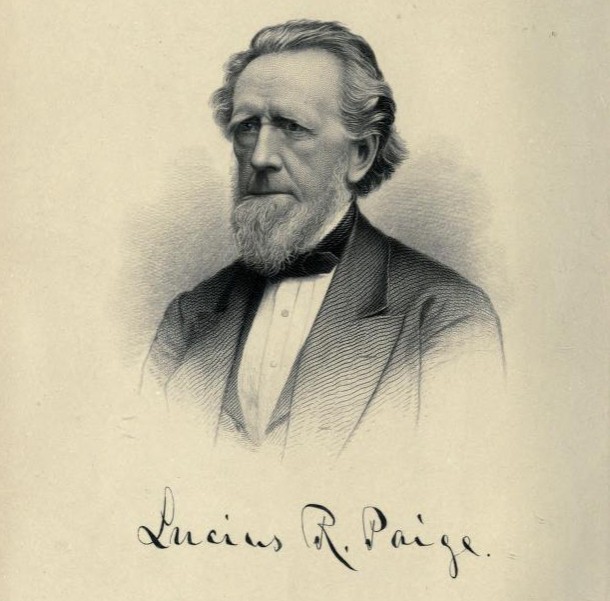
Do You Know This Man? Cambridge Historians Do Lucius Paige: Polymath, Theologian, Reverend, Historian, Author, and Town Clerk Extraordinaire
Portrait of Lucius R. Paige as published in his History of Cambridge, Massachusetts (1877)
In a town known for its illuminati, Lucius Paige is usually not top of mind. But, without his mind we would not know as much about early Cambridge as we do. Why is that?
Professional Life
Lucius Paige was Transcriber-in-Chief of the oldest Cambridge City Records dating back to the early 1600s. Not only did he transcribe the City’s records, but he also scoured the Massachusetts Historical Society, the Records and Archives of the Commonwealth, judicial and court documents, the records of several relevant surrounding towns, and any other historical depositories that were available. His book The History of Cambridge, Massachusetts 1630-1877, with a Genealogical Register, published in 1877, is an astonishing accomplishment that has brought to life the earliest history of the city. His book illuminates the thoughtfulness the first settlers brought to organizing a town government and civil society. The reach of his research, and his skill in organizing his studies into a comprehensible narrative, has made ordinary life in Cambridge from the 1600s onward accessible. This extensively footnoted book is the go-to source for Cambridge history from the period of early settlement to its development as a bustling city.
For instance, from Paige’s transcribed, typeset, and proofed pages, it is easy to find the exact date that the town Cambridge got its name:
p. 43
Lucius Robinson Paige was born in 1802 in Hardwick, Massachusetts. He was educated at what would become Hopkins Academy in Hadley, Mass. Raised in a Calvinist household, he became a Unitarian and began preaching at the age of 21. He left active preaching in 1839 and became the Town Clerk until 1846 and then City Clerk until 1855, participating in that historic transition of municipal government. He was Justice of the Peace (1843), Representative to the Massachusetts Court (1878-1879), and served on several bank and business boards. He was one of the earliest members of the New England Historic Genealogical Society. He received an honorary MA from Harvard in 1850. He was an early contributor to Tufts and served on its board of trustees for 14 years. In 1861, Tufts University awarded Paige an honorary Doctor of Divinity.
It was during his stint as the Town Clerk of Cambridge that Paige found the town’s municipal records in dismal order. He contracted with the City to transcribe them. For transcribing the first volume he was paid $250 for 550 pages. Then, on May 3, 1841, he wrote to the Selectmen:
“The records of the Proprietors of Cambridge are in a shattered, perishingcondition, and a considerable portion of them are written in the ancientcharacter, and, to most persons, are illegible. They are believed to containmatter too valuable to be lost; but they cannot easily be preserved and madeavailable, except by transcribing them.”
He was willing to transcribe the Proprietor’s Records for the same price, even though they would amount to approximately 250 more pages than the first project, because “as I have become familiar with the hand-writing, my actual labor will not be greater in the same proportion.” Yet he had to confess that: “At the same time, I will not disguise the fact, that I feel an interest in this subject, not only as a citizen of the Town, but also as an individual.”
The Town agreed. As he states in the preface to his book in 1877, the Genealogical Registry “is chiefly confined to the families who dwelt in Cambridge before the year 1700…” Paige also comments that “comparatively few recent events are mentioned. It would be impracticable, in a single volume, to include with our ancient annals everything which those who are now living have witnessed, and to trace the genealogy of all our nearly fifty thousand inhabitants.”
In his usual self-effacing way, he acknowledges that some might find the history short on Harvard details, the Revolution, or “legendary lore.” Addressing the latter, he states that, because he was not born in Cambridge, he had “no opportunity in the first 30 years of my life to gather the local traditions which so deeply impress the youthful mind…”
His diagram of the city of Cambridge in 1635 was accompanied by the names of each of the 63 land holders in the numbered diagram below. These included four of the first inhabitants listed on the title page of the Town Book of Newtowne, first begun in 1632: Simon Bradstreet (#27) Thomas Dudley (#55), William Spencer (#31), and the widow of Symon Sacket (#37). The area marked #24, designated the “Marketplace,” is now Winthrop Square.
Apart from recording the standard history of land development and civil government, from these pages we also learn about such 17th-century charming esoterica as:
Keeping goats (pg. 41)
Roaming dogs (pg. 96-7)
The comfort of cows (January 4, 1635-6, pg. 37)
Chickens running loose. (April 4, 1636, pg. 39)
More serious subjects include:
Early city planning (January 7, 1632-3, pg. 18)
House fires (pg. 56)
The Cambridge History Room in the city’s Public Library holds a collection of Paige’s original drafts in his own handwriting, which, interestingly, include his editorial corrections:
The layout of this genealogical chart is particularly interesting:
Paige’s prodigious published output is remarkable. Not only did he publish TheHistory of Cambridge, but, at the same time, he produced other histories, religious tracts, and genealogies:
Lucius R. Paige was a direct descendent of William Brewster, who came to New England on the Mayflower, and the Governor of the Massachusetts Bay Colony Thomas Dudley. His grandfather served in the Revolutionary War and his father was a Minute Man. The earliest digitized Town Directory is 1847, which finds him living at 96 Washington Street. He lived there for at least 20 years before moving to 112 Washington St.
Paige apparently suffered from poor health, as this excerpt from an article in the Boston Globe (June 30, 1914) describes:
Paige’s adult life was rife with sadness. He lost three wives; only his fourth wife, Ann Maria Peek, whom he married in 1866, survived him. She died five years later in 1901. He had five children, only two of whom reached the age of 25. Three died in infancy. This included his first child, named Hosea Ballou Paige, in honor of Paige’s mentor Hosea Ballou. Ballou is buried in Mt. Auburn, Lot #103 Central Ave.
Paige’s death notice in The Boston Globe September 3, 1896
Lucius Robinson Paige is buried in the Mount Auburn Cemetery, Lot #2008 Sorrel Path. He was initiated into the Masons as a clergyman in 1824 – the Mason symbol can be seen on his headstone. Each of his family members are buried in this lot.
The Paige family lot at Mount Auburn Cemetery
Headstone of Lucius R. Paige
A toad stands sentinel on his monument. Photographs by Kathleen M. Fox, 2024.
Today’s post was written by CHC volunteer Kathleen M. Fox
Sources
Ancestry.com Cambridge Historical Commission reference files Cambridge Public Library’s Historic Cambridge Newspaper Collection Kenney, Michael and Cambridge Historical Commission. The Streets of Cambridge: An Engineer’s Passion (2018). https://www.cambridgema.gov/-/media/Files/historicalcommission/pdf/hastings_engineer.pdf. Lucius R. Paige Papers, 1644-1881, Cambridge Room, Cambridge Public Library Archives and Special Collections. Mount Auburn Cemetery Newspapers.com North America, Family Histories, 1500-2000 [database on-line]. Ancestry.com.
The latest edition of the Mapping Feminist Cambridge walking tour, this time featuring Harvard Square, will launch next week. Sign up to reserve your spot!
The Women’s Commission is thrilled to launch the third and final tour of the Mapping Feminist Cambridge series, Harvard Square 1970s-1990s, with two walking tours July 25, 6-8pm and August 11, 2-4pm. Click below to sign up:
Throughout the 1970s to 1990s, Harvard Square activists organized around labor rights, housing justice, education, lesbian advocacy, music, poetry, and more. Come learn about women’s entrepreneurship in the emerging hospitality sector and how many of the restaurants and inns from this era became long-standing establishments, hear about the vibrant music scene in coffee houses and on street corners, discover feminist art tucked into alley ways, and learn how Cambridge youth were also making their mark. While organizing at Harvard University is included in this tour, the primary focus is on local grassroots activism and organizing.
319th Harvard commencement interrupted by Saundra Graham and activists from the Riverside neighborhood, photographed by Associated Press on June 11, 1970 (via Digital Commonwealth)
Mapping Feminist Cambridge is a series of three historic tours focused on the feminist movement in Cambridge from the 1970s–1990s. From the takeover of 888 Memorial Drive, to the formation of the first domestic violence shelter on the East Coast, to one of the earliest feminist bookstores, to the home of one of the initial women’s studies courses – Mapping Feminist Cambridge is a vibrant account of feminist organizing and politics. Each tour – Inman Square, Central Square, and Harvard Square – spans several organizations and provides context about the movement and its priorities including racial equity, reproductive health care and abortion access, women in film and print, healing for survivors, lesbian and bisexual visibility, political collectives, and so much more.